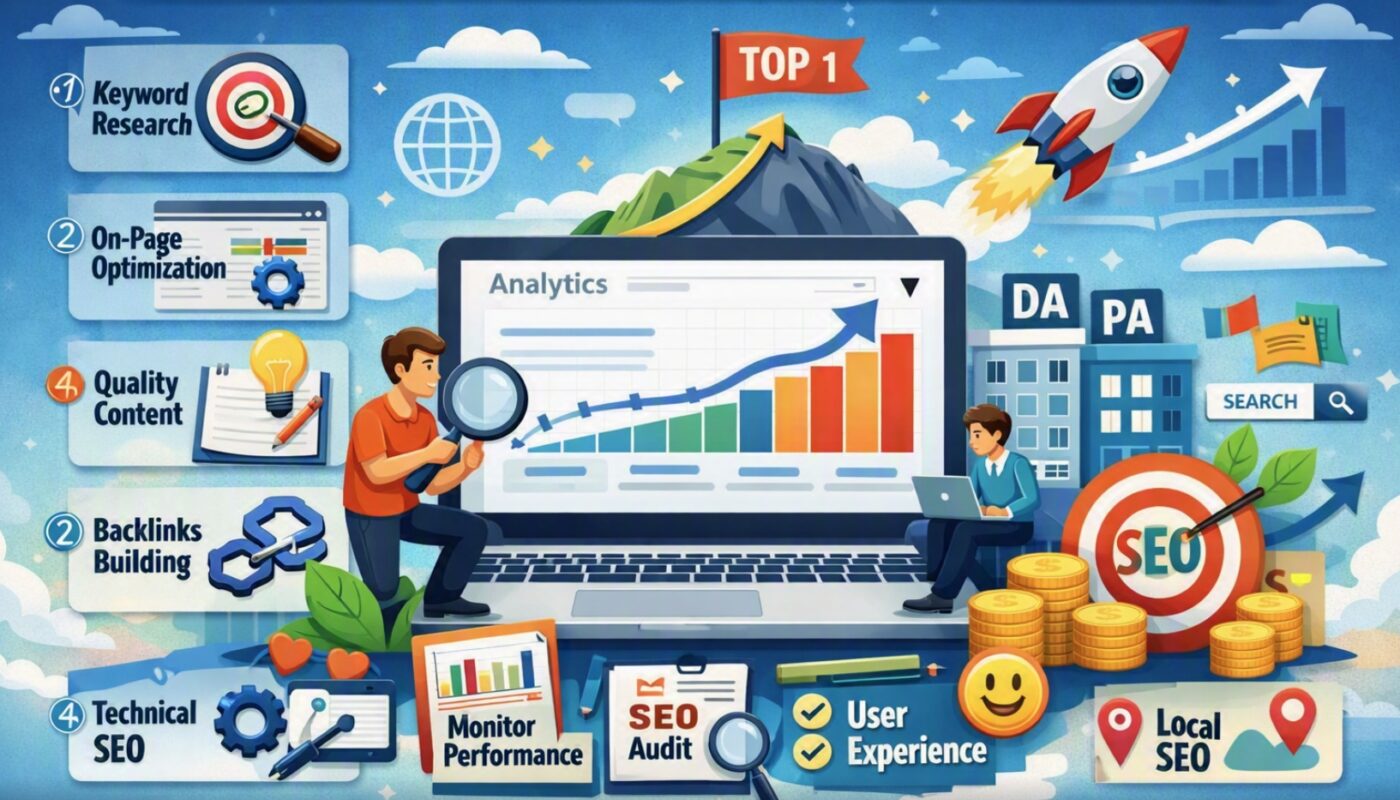
Launching a new website is exciting, but getting it to appear prominently in Google Search can be challenging. A beautiful website alone is not enough to attract organic traffic, generate leads, or build a strong online presence. New websites need a clear SEO strategy that helps search engines discover, understand, index, and eventually rank their pages.
So, how to rank a new website successfully?
The answer is not a single SEO trick. Sustainable rankings come from combining technical SEO, useful content, keyword research, website structure, internal linking, authority building, user experience, and consistent improvement.
For businesses, ranking a new website is especially important because organic search can become a long-term source of qualified visitors. Instead of depending entirely on paid advertising, a well-optimized website can attract people who are actively searching for the products, services, information, or solutions that a business provides.
This guide explains how to rank a new website on Google, what to prioritize during the first few months, how to improve indexing, how to create content that deserves visibility, and which SEO mistakes new websites should avoid.
Why Is It Difficult to Rank a New Website?
A new website usually starts with very little search visibility. Google needs to discover its pages, crawl them, understand their content, determine which URLs are canonical, and evaluate their usefulness and relevance before the pages can compete effectively in search results.
There is also competition.
Established websites may already have years of content, trusted backlinks, strong brand recognition, and a large collection of useful pages. A new website therefore needs to demonstrate genuine value rather than simply publishing large quantities of keyword-focused content.
Google’s search systems also actively address spam and manipulative practices. For example, Google identifies scaled content abuse as creating many pages primarily to manipulate rankings rather than helping users. (Google for Developers)
That means the goal should not simply be to produce more pages.
The goal should be to produce better pages that solve real searcher problems.
How to Rank a New Website: Start With the Right SEO Foundation
Before publishing dozens of articles or building backlinks, establish a strong technical and strategic foundation.
A new website should have:
- A clear website structure
- Search-friendly URLs
- Fast and reliable hosting
- Mobile-friendly pages
- HTTPS
- Proper indexing settings
- XML sitemap
- Robots.txt configuration
- Canonical URLs where appropriate
- Descriptive page titles
- Useful meta descriptions
- Proper heading structure
- Internal links
- High-quality original content
- Clear business information
- Strong conversion paths
SEO works best when technical optimization and content strategy work together.
If Google cannot properly crawl or understand a website, excellent content may struggle to gain visibility.
1. Perform Keyword Research Before Creating Content
One of the first steps in learning how to rank a new website is understanding what your potential customers search for.
Keyword research identifies the words and phrases people use when looking for information, products, services, and solutions.
For example, a digital marketing company might target keywords such as:
- How to improve website SEO
- How to rank a new website
- How to increase organic traffic
- SEO strategies for small businesses
- How to get more website visitors
- How to improve Google rankings
- Best SEO strategy for a new website
- How to build website authority
However, don’t target every keyword simply because it has search volume.
The best keywords are connected to your business objectives and search intent.
Understand Search Intent
Search intent refers to the reason behind a search.
A user searching for:
“What is SEO?”
is probably looking for educational information.
Someone searching for:
“SEO agency Australia”
may be looking for a service provider.
Someone searching for:
“best SEO software”
may be comparing solutions.
Your content should match the intent behind the keyword.
When the content satisfies the searcher’s actual need, it has a better opportunity to provide value and attract engagement.
2. Create a Logical Website Structure
A new website should make it easy for both users and search engines to navigate.
A simple structure might look like:
Home → Services → Individual Service Pages → Blog → Supporting Articles
For example:
- Home
- SEO Services
- Web Design
- Digital Marketing
- Local SEO
- Technical SEO
- SEO Blog
- SEO Guides
- Contact
This structure helps establish topical relationships between pages.
A well-organized site also makes internal linking easier.
Avoid creating hundreds of disconnected pages that are difficult to reach through normal navigation.
3. Make Sure Google Can Discover Your Website
Before worrying about rankings, make sure Google can find your pages.
Google uses automated crawlers to discover web content. However, publishing a page does not guarantee immediate indexing.
A new website should therefore be connected to Google Search Console.
After verification, you can:
- Submit your XML sitemap
- Inspect URLs
- Monitor indexing
- Identify indexing problems
- Review search performance
- Find technical issues
- Monitor search queries
- Request indexing for important pages when appropriate
Google’s documentation notes that it can take several days after publishing a page for Google to find and crawl it.
Therefore, don’t panic if a brand-new article does not appear in Google immediately.
4. Create and Submit an XML Sitemap
An XML sitemap helps search engines discover important URLs on your website.
For a new website, the sitemap should generally include the canonical URLs that you want search engines to know about.
For example:
- Homepage
- Important service pages
- Category pages
- High-quality blog articles
- Important landing pages
After creating your sitemap, submit it through Google Search Console.
A sitemap does not automatically make pages rank, but it can help Google discover URLs more efficiently.
5. Optimize Your Website’s Technical SEO
Technical SEO creates the foundation on which your content strategy operates.
Important technical areas include:
Mobile Optimization
Most modern websites receive visitors from mobile devices. Your website should be easy to navigate and read on smartphones and tablets.
Check:
- Font size
- Button spacing
- Navigation
- Image scaling
- Page layout
- Forms
- Pop-ups
- Mobile loading performance
HTTPS
Use HTTPS throughout the website.
Security is important for users and modern websites, particularly when visitors submit personal information or complete transactions.
Page Speed
Slow websites can create a poor user experience.
Optimize:
- Images
- CSS
- JavaScript
- Fonts
- Server response
- Caching
- Third-party scripts
Don’t optimize speed simply to chase a score. Focus on creating a fast, usable experience for real visitors.
6. Write High-Quality, Original Content
Content remains one of the most important components of a successful SEO strategy.
But publishing content simply because you want more indexed pages is not an effective long-term strategy.
Instead, ask:
Does this page provide something genuinely useful that a searcher needs?
A strong article should:
- Answer the main question
- Explain the subject clearly
- Provide practical information
- Use examples
- Address related questions
- Be easy to scan
- Avoid unnecessary repetition
- Add original insights
- Link to useful supporting resources
Google’s spam policies specifically warn against scaled content created primarily to manipulate search rankings. This can include large amounts of low-value content generated or assembled without meaningful value for users.
Therefore, focus on quality, relevance, originality, and usefulness.
7. Build Topic Clusters
One powerful way to rank a new website is to build topical depth.
Instead of publishing unrelated articles, create groups of content around important subjects.
For example, if your primary business topic is SEO, your content cluster could include:
Pillar Page
Complete Guide to SEO for Small Businesses
Supporting articles:
- How to Rank a New Website
- How to Perform Keyword Research
- How to Improve Technical SEO
- How to Build Internal Links
- How to Write SEO-Friendly Content
- How to Improve Local SEO
- How to Monitor Google Rankings
- How to Build Quality Backlinks
These pages can be internally linked to one another.
This creates a clear topical ecosystem and gives users multiple useful resources.
8. Optimize Page Titles and Headings
Your page title tells users and search engines what the page is about.
For this article, a strong title is:
How to Rank a New Website: Proven SEO Strategies for Business Growth
It naturally includes the target keyword while communicating the benefit of the article.
Use headings to organize the page.
For example:
- H1: How to Rank a New Website
- H2: Why Is It Difficult to Rank a New Website?
- H2: How to Rank a New Website: Start With the Right SEO Foundation
- H2: Perform Keyword Research
- H2: Create a Logical Website Structure
- H2: Build Quality Content
- H2: Develop a Backlink Strategy
Avoid stuffing the same keyword into every heading.
Write headings for humans first.
9. Use Related Keywords Naturally
Modern SEO is not about repeating one keyword hundreds of times.
A comprehensive article naturally discusses related concepts.
For the keyword “How to Rank a New Website,” related terms might include:
- Google rankings
- SEO strategy
- organic traffic
- keyword research
- technical SEO
- search engine optimization
- Google Search Console
- backlinks
- internal linking
- search intent
- website indexing
- content marketing
- local SEO
- website authority
- organic search
Use these terms when they genuinely fit the topic.
The objective is to create comprehensive content, not artificially increase keyword density.
10. Build a Strong Internal Linking Strategy
Internal links connect one page on your website to another.
For example, an article about ranking a new website could link to:
- SEO services
- Technical SEO
- Keyword research
- Local SEO
- Content marketing
- Website design
Internal links help users discover related information and help search engines understand relationships between pages.
When adding internal links, use descriptive anchor text.
Instead of:
Click here
use something more informative, such as:
learn how to perform keyword research
The anchor text should accurately describe the destination page.
11. Create Content for Different Stages of the Buying Journey
A business website shouldn’t only publish informational articles.
Create content for different stages of the customer journey.
Awareness Content
Examples:
- What is SEO?
- Why does SEO matter?
- How does Google Search work?
Consideration Content
Examples:
- SEO vs PPC
- Best SEO strategies for small businesses
- How much does SEO cost?
Decision Content
Examples:
- SEO service packages
- SEO agency comparison
- Technical SEO services
- Local SEO services
This approach helps a website attract visitors and guide them toward becoming customers.
12. Build High-Quality Backlinks
Backlinks are links from other websites to your website.
A new website often needs to earn relevant mentions and links as part of its authority-building strategy.
However, quality matters more than simply collecting huge numbers of links.
Good link-building opportunities may include:
- Industry publications
- Relevant business directories
- Expert interviews
- Digital PR
- Original research
- Useful resources
- Editorial guest contributions
- Industry associations
- Business partnerships
- Relevant resource pages
Avoid aggressive link schemes designed solely to manipulate rankings.
Google’s spam policies prohibit techniques intended to manipulate search systems and may result in lower rankings or exclusion from search.
For businesses, the best backlink strategy is usually to create something worth referencing.
13. Use Guest Posting Strategically
Guest posting can be useful when the primary purpose is to reach a relevant audience and provide editorial value.
For example, a technology business could contribute an original article to a relevant technology publication.
The article should:
- Be original
- Be useful
- Match the publication’s audience
- Provide genuine expertise
- Avoid excessive promotional language
- Use links appropriately
Don’t publish the same article across dozens of websites.
Don’t create guest posts purely to generate artificial backlinks.
The objective should be visibility, expertise, referral traffic, relationships, and legitimate editorial exposure.
14. Optimize Images for SEO
Images improve the readability and visual quality of content, but they should also be technically optimized.
Use:
- Descriptive filenames
- Appropriate image formats
- Compressed images
- Useful alt text
- Responsive image dimensions
- Relevant captions when appropriate
For example:
Instead of:
IMG12345.jpg
use:
how-to-rank-new-website-seo-strategy.jpg
Alt text should describe the image when appropriate rather than stuffing keywords.
15. Improve Your Website’s User Experience
SEO is not just about search engines.
Your website needs to work for people.
A visitor should quickly understand:
- What your business does
- Who you help
- What you offer
- Why they should trust you
- What they should do next
Use clear navigation, readable typography, logical layouts, strong calls to action, and accessible contact information.
If visitors arrive through Google but cannot understand your offer, rankings alone will not create business growth.
16. Establish Trust and Expertise
New websites have to work harder to establish credibility.
Include information such as:
- About the company
- Author information
- Contact details
- Business location where relevant
- Service information
- Customer testimonials where legitimate
- Case studies
- Original research
- References
- Editorial standards
For business websites, transparency can help users understand who is behind the content and why they should trust it.
17. Use Structured Data Where Appropriate
Structured data provides search engines with additional information about the content of a page.
Depending on the website, relevant structured data may include:
- Organization
- LocalBusiness
- Article
- Breadcrumb
- Product
- Event
- Review
Only use structured data that accurately represents the page.
Do not add misleading or inaccurate markup simply to try to obtain enhanced search features.
18. Avoid Duplicate Content and Canonical Problems
New websites sometimes accidentally create multiple URLs for essentially the same content.
Examples can include:
- HTTP and HTTPS versions
- www and non-www versions
- URL parameters
- Duplicate category pages
- Tracking URLs
- Multiple versions of the same article
Google explains that canonicalization is the process of selecting the representative URL when multiple URLs contain the same or very similar content.
Make sure your important pages have clear canonical signals and that internal links consistently point toward preferred URLs.
19. Monitor Indexing Instead of Assuming Everything Is Indexed
One common mistake is assuming:
Published = Indexed = Ranking
These are three different things.
A page can be:
- Published but not discovered
- Crawled but not indexed
- Indexed but receiving little traffic
- Indexed and ranking poorly
- Indexed and ranking successfully
Use Google Search Console to understand which situation applies.
If an important page isn’t indexed, investigate possible causes such as:
- Noindex directives
- Robots.txt restrictions
- Canonicalization
- Duplicate content
- Poor internal linking
- Server problems
- Low-value content
- Crawling issues
20. Create a Consistent Publishing Strategy
You don’t need to publish ten articles every day.
A better approach is to create a sustainable publishing schedule.
For example:
Month 1
- Homepage optimization
- Core service pages
- About page
- Contact page
- Five high-quality informational articles
Month 2
- Five additional supporting articles
- Internal linking
- Technical SEO improvements
- Initial digital PR or outreach
Month 3
- Update existing content
- Publish supporting content
- Build relevant links
- Analyze Search Console data
Consistency matters more than publishing massive quantities of low-quality content.
21. Update Existing Content
SEO is not a one-time activity.
Search behavior changes. Competitors publish new content. Information becomes outdated. Google continuously improves its search systems.
Google’s Search Central documentation notes that smaller algorithmic changes occur continuously, and improvements to content can lead to improved visibility without necessarily waiting for a major core update.
Review your best-performing articles regularly.
Look for:
- Outdated statistics
- Broken links
- Missing questions
- Better examples
- New developments
- Weak sections
- Opportunities for internal links
- New search queries
Improving an existing strong page can sometimes be more valuable than publishing another completely new article.
22. Measure SEO Performance
You cannot improve what you don’t measure.
Important SEO metrics include:
- Organic clicks
- Organic impressions
- Average position
- Click-through rate
- Indexed pages
- Organic conversions
- Leads
- Revenue
- Backlinks
- Referring domains
- Engagement metrics
Google Search Console is particularly useful for understanding how pages appear in Google Search.
Analytics tools can then help you understand what visitors do after arriving on your website.
The ultimate goal is not simply:
“How many visitors did SEO generate?”
The better question is:
“How many valuable customers did organic search generate?”
23. Create a 90-Day SEO Plan
If you are wondering how to rank a new website fast, remember that sustainable SEO generally requires patience.
Instead of looking for shortcuts, follow a structured plan.
Days 1–30: Foundation
Focus on:
- Technical SEO
- Website structure
- Keyword research
- Search Console
- Sitemap
- Robots.txt
- Core service pages
- Initial content
- Internal linking
Days 31–60: Content and Authority
Focus on:
- Publishing supporting content
- Building topic clusters
- Improving internal links
- Creating useful resources
- Digital PR
- Relevant outreach
- Earning quality backlinks
Days 61–90: Optimization
Focus on:
- Search Console analysis
- Content updates
- CTR improvements
- Technical fixes
- Conversion optimization
- New keyword opportunities
- Expanding successful topic clusters
This approach creates a sustainable foundation rather than relying on shortcuts.
24. Don’t Chase Rankings With Black-Hat SEO
New websites can be tempted by promises such as:
- Guaranteed #1 rankings
- Thousands of backlinks overnight
- Automated SEO
- Instant Google indexing
- Private blog network links
- Keyword stuffing
- Mass-generated pages
These strategies can create serious long-term risks.
Google’s spam policies state that violations can result in lower rankings or pages not appearing in search results at all. (Google for Developers)
Sustainable SEO should focus on:
Useful content + technical accessibility + relevant authority + strong user experience + continuous improvement.
25. How Long Does It Take to Rank a New Website?
There is no guaranteed ranking timeline.
Some pages may appear in search relatively quickly, while competitive keywords can require much more time.
The timeline depends on:
- Competition
- Website quality
- Content depth
- Search intent
- Technical SEO
- Domain history
- Relevant authority
- Backlinks
- Industry
- Search demand
- Content quality
- Consistency
Google’s documentation also makes clear that crawling and processing can take time. Even when pages are submitted correctly, there is no guaranteed instant indexing or ranking result.
Therefore, don’t measure your SEO campaign only after a few days.
Measure progress over months.
Read More store: Gemini AI for Marketers
A Practical SEO Checklist for a New Website
Before launching an SEO campaign, check the following:
Technical SEO
- HTTPS enabled
- Mobile-friendly design
- Fast hosting
- XML sitemap
- Robots.txt
- Search Console verified
- Important pages indexable
- No accidental noindex tags
- Correct canonical URLs
- Clean URL structure
On-Page SEO
- Unique page titles
- Useful meta descriptions
- One clear H1
- Logical H2/H3 headings
- Relevant keywords
- Helpful content
- Optimized images
- Internal links
- Clear calls to action
Content SEO
- Original articles
- Search-intent matching
- Topic clusters
- Helpful examples
- Updated information
- Author credibility
- Relevant references
- No keyword stuffing
Authority Building
- Relevant backlinks
- Digital PR
- Industry relationships
- Guest contributions
- Business profiles
- Original research
- Useful resources
Measurement
- Search Console
- Analytics
- Organic traffic
- Search impressions
- Click-through rate
- Rankings
- Leads
- Conversions
Final Thoughts: How to Rank a New Website Successfully
So, how to rank a new website in Google?
The most reliable answer is to build a website that deserves to rank.
Start with a technically accessible website. Research the right keywords. Understand search intent. Create genuinely useful content. Organize that content into meaningful topic clusters. Build strong internal links. Earn relevant and trustworthy backlinks. Improve the user experience. Monitor Google Search Console. Update your content. Measure business results and continuously improve.
Most importantly, don’t confuse SEO with a race to publish the largest number of pages.
A new website can compete with established websites when it provides a better, clearer, more useful experience for a specific audience.
SEO is a long-term business investment. The goal isn’t simply to achieve a temporary position in Google. The goal is to build a website that consistently attracts qualified visitors, earns trust, generates leads, and supports sustainable business growth.
For businesses building their online presence, the best SEO strategy is therefore simple in principle—even if execution requires consistent effort:
Create something valuable, make it easy for search engines to understand, make it easy for people to use, and keep improving it over time.
That is the foundation for sustainable organic growth.